| Storage | This product can be stored at 2~8℃ for 1 year in the dark. |
| shipping | Ice bag |
| Exp date | 12 months |
| Category ID_I | Apoptosis and Cell Health Detection |
| Category ID_II | Cell Apoptosis |
| Category ID_III | Caspase Assay Kits |
| Описание на сайте производителя | ссылка |
| Инструкция | ссылка |
| MSDS | ссылка |
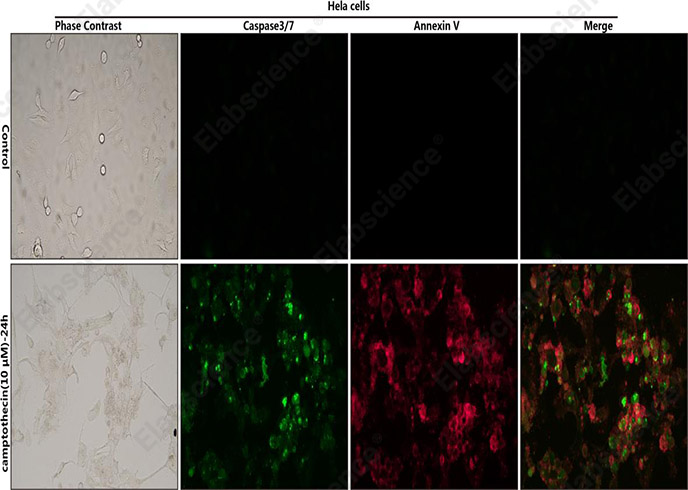
Control: Normal Hela cells were not treated with camptothecin.
Camptothecin (10μM)-24h: Hela cells were treated with 10 μM camptothecin for 24h.
 |
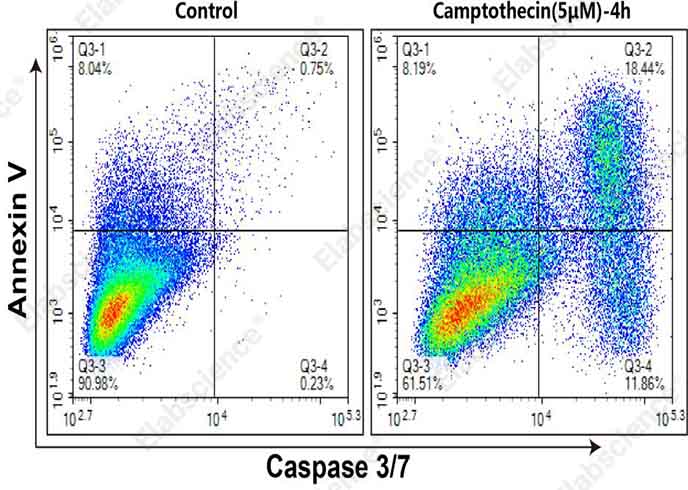
MOLT-4 cells were cultured without (Left) or with (Right) 5 μM Camptothecin for 4 h. Annexin V-APC single-positive cells (Q3-1) were early apoptotic cells with phosphatidylserine translocation.
Annexin V and Caspase 3/7 double-positive cells (Q3-2) were apoptotic cells with higher Caspase 3/7 activity in early to mid-late Stage. Caspase 3/7 single-positive cells (Q3-4) were early apoptotic cells with caspase 3/7 activation.
 |
 |
| Detection Instrument | Flow Cytometer |
| Tested Sample Types | Cell samples |
| Assay Time | 0.5 hour |
| Detection Type | Fluorometric method;Flow cytometry |
| Test Principle | The Caspase 3/7 Substrates(Green)are based on novel fluorogenic DNA dyes that have been coupled to the caspase 3/7 recognition sequence (DEVD),which is both non-fluorescent and nonfunctional as a DNA dye.When it rapidly crosses cell membranes to enter the cytoplasm and cleaved by caspase 3/7 to form a high-affinity DNA dye that stains the nucleus bright green. Thus, the Caspase 3/7 substrates allow detection of caspase 3/7 activity and visualization of apoptotic nuclear morphology simultaneously.
Annexin V is a member of the annexin family, which binds to phosphatidylserine (PS) in a calcium-dependent manner. Annexin V-APC, the APC-conjugated format, binds specifically to the PS on the outer leaflet apoptotic cell membrane and can be detected with flow cytometry or fluorescence microscopy.
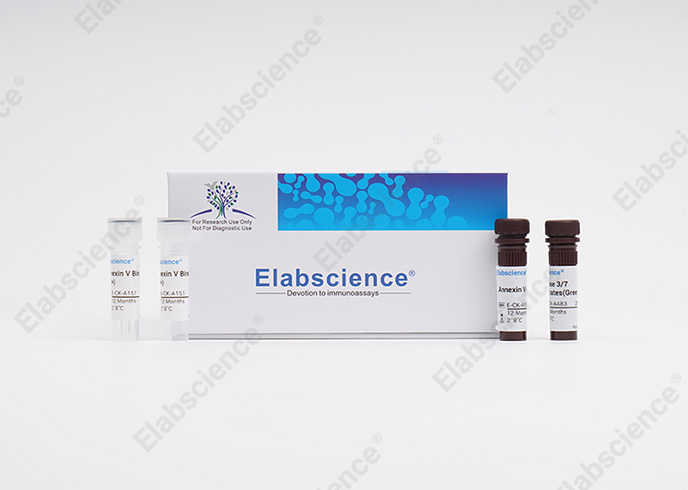
Elabscience<sup>®</sup> Caspase 3/7 and Annexin V Double Staining Apoptosis Kit includes Caspase 3/7 Substrates(Green)和Annexin V-APC Reagent, enables the user to detect two important apoptosis events, caspase 3/7 activation and phosphatidylserine (PS) translocation. |
| | |