| Storage | This product can be stored at -20°C for 12 months with shading light. |
| shipping | Ice bag |
| Exp date | 12 months |
| Category ID_I | Apoptosis and Cell Health Detection |
| Category ID_II | Cell Cytotoxicity and Viability |
| Category ID_III | Calcein AM/PI Double Staining Kit |
| Описание на сайте производителя | ссылка |
| Инструкция | ссылка |
| MSDS | ссылка |
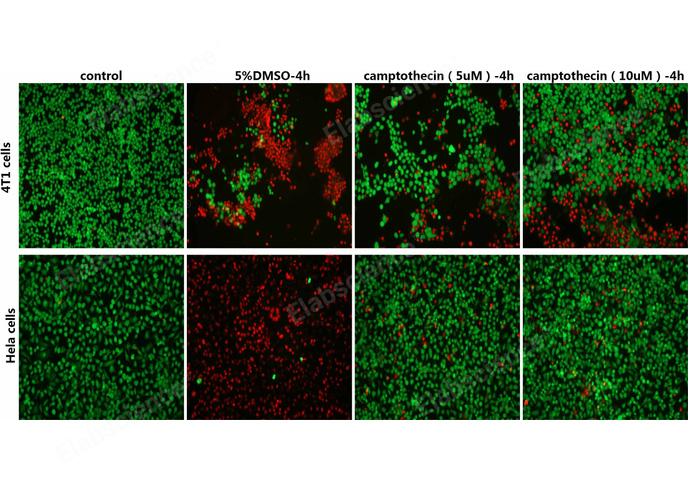
4T1 cells and Hela cells were treated with 5 % DMSO, 5μM Camptothecin, 10μM Camptothecin for 4h, then stained with Calcein-AM / PI Double Staining Kit and photographed.
 |
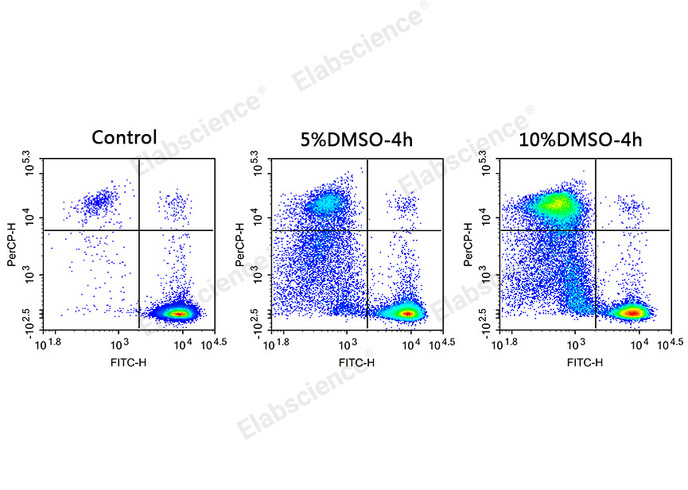
Molt-4 cells were treated with 5 % DMSO and 10 % DMSO for 4h, then stained with Calcein-AM / PI Double Staining Kit and detected by flow cytometry.
 |
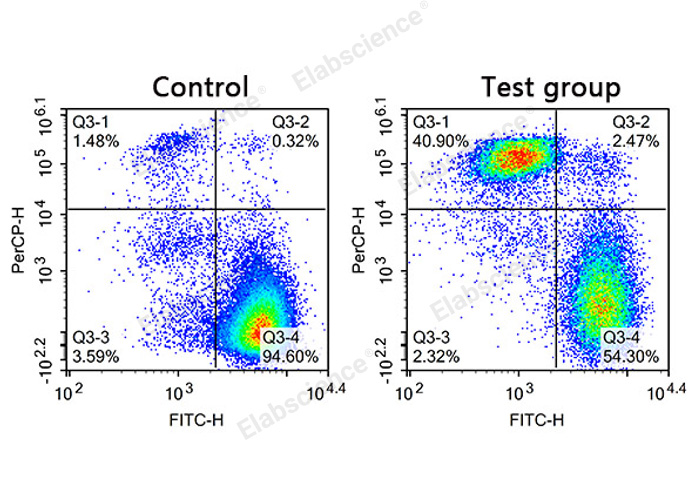
Jurkat cells were placed at 4 °C for 20 days, then stained with Calcein-AM / PI Double Staining Kit and detected by flow cytometry.
 |
 |
| Citation link 1 | ссылка |
| Kit Type | Viability/Cytotoxicity |
| Detection Instrument | Flow Cytometer;Fluorescence Microscope |
| Tested Sample Types | Cell samples |
| Assay Time | 30 min |
| Detection Type | Fluorometric method;Flow cytometry |
| Test Principle | Elabscience<sup>®</sup> Calcein AM Solution (100 μM) can be used to distinguish living cells in mammals with esterase activity. Calcein AM is the addition of acetyl methoxy methyl ester (AM) group to traditional Calcein, which increases hydrophobicity and can easily penetrate the living cell membrane and enter the cell. Calcein AM itself has no fluorescence. After entering the cell, it is hydrolyzed by endogenous esterase in the cell to produce Calcein, a polar molecule with strong negative charge and cannot be retained in the cell through the cell membrane, while Calcein can emit strong green fluorescence ( Ex/Em = 494nm/517nm ). Due to the lack of esterase, dead cells cannot or rarely produce Calcein, so only living cells are stained with strong green fluorescence, and dead cells cannot be stained or stained very weakly. Compared with other live cell staining probes, Calcein AM is less toxic and does not affect cell differentiation and proliferation. |
| | |