| Clonality | polyclonal |
| Host | Rabbit |
| Specificity | Human, Mouse |
| Tested Application | ELISA, WB, IHC, IF |
| Delivery Time | 2 to 4 working days |
| Isotype | IgG |
| Form | liquid |
| Purification | Immunogen affinity purified |
| Purity | ≥95% as determined by SDS-PAGE |
| Uniprot ID | Q96T21 |
| Gene ID | |
| Calculated MW | 110 kDa |
| Ссылка на страницу на сайте производителя | ссылка |
| Инструкция | PDF |
| Storage | PBS with 0.02% sodium azide and 50% glycerol pH 7.3 , -20℃ for 12 months (Avoid repeated freeze / thaw cycles.) |
| Background | The incorporation of selenocysteine into a protein requires the concerted action of an mRNA element called a sec insertion sequence (SECIS), a selenocysteine-specific translation elongation factor and a SECIS binding protein. With these elements in place, a UGA codon can be decoded as selenocysteine. The gene described in this record encodes a nuclear protein that functions as a SECIS binding protein. Mutations in this gene have been associated with a reduction in activity of a specific thyroxine deiodinase, a selenocysteine-containing enzyme, and abnormal thyroid hormone metabolism. Alternate splicing results in multiple transcript variants. |
| Immunogen | SECIS binding protein 2 |
| Synonyms | SBP2 |
| Recommended dilution | WB: 1:500 - 1:2000; IHC: 1:50 - 1:200; IF: 1:50 - 1:100 |
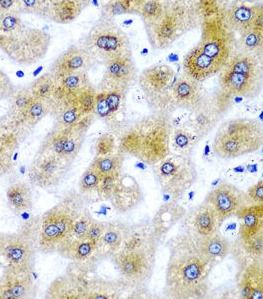
Immunohistochemistry of paraffin-embedded human liver injury using FNab07695(SECISBP2 antibody) at dilution of 1:100
 |
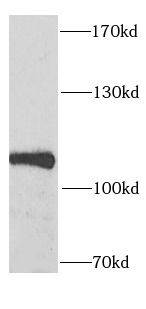
HeLa cells were subjected to SDS PAGE followed by western blot with FNab07595(SECISBP2 antibody) at dilution of 1:1000
 |
| | |